
The Website Trap
Digital Operations Architecture exists because of a pattern we see every year. Thousands of SMEs invest in a website expecting it to transform their business. They hire a web agency, get a polished design, and launch it. Then nothing changes. The website sits there like a digital brochure that nobody visits. Meanwhile, the business keeps running on spreadsheets, manual emails, and disconnected tools.
In this article
This is not a design problem. Vietnam's digital economy reached USD 72.1 billion in 2025, and SMEs are spending more than ever on digital tools. However, most of that spending goes into isolated pieces rather than a system. A website comes from one vendor, a CRM from another, and an automation tool gets bolted on later. None of them talk to each other.
The problem is not the website. The problem is the approach.
What Is Digital Operations Architecture?
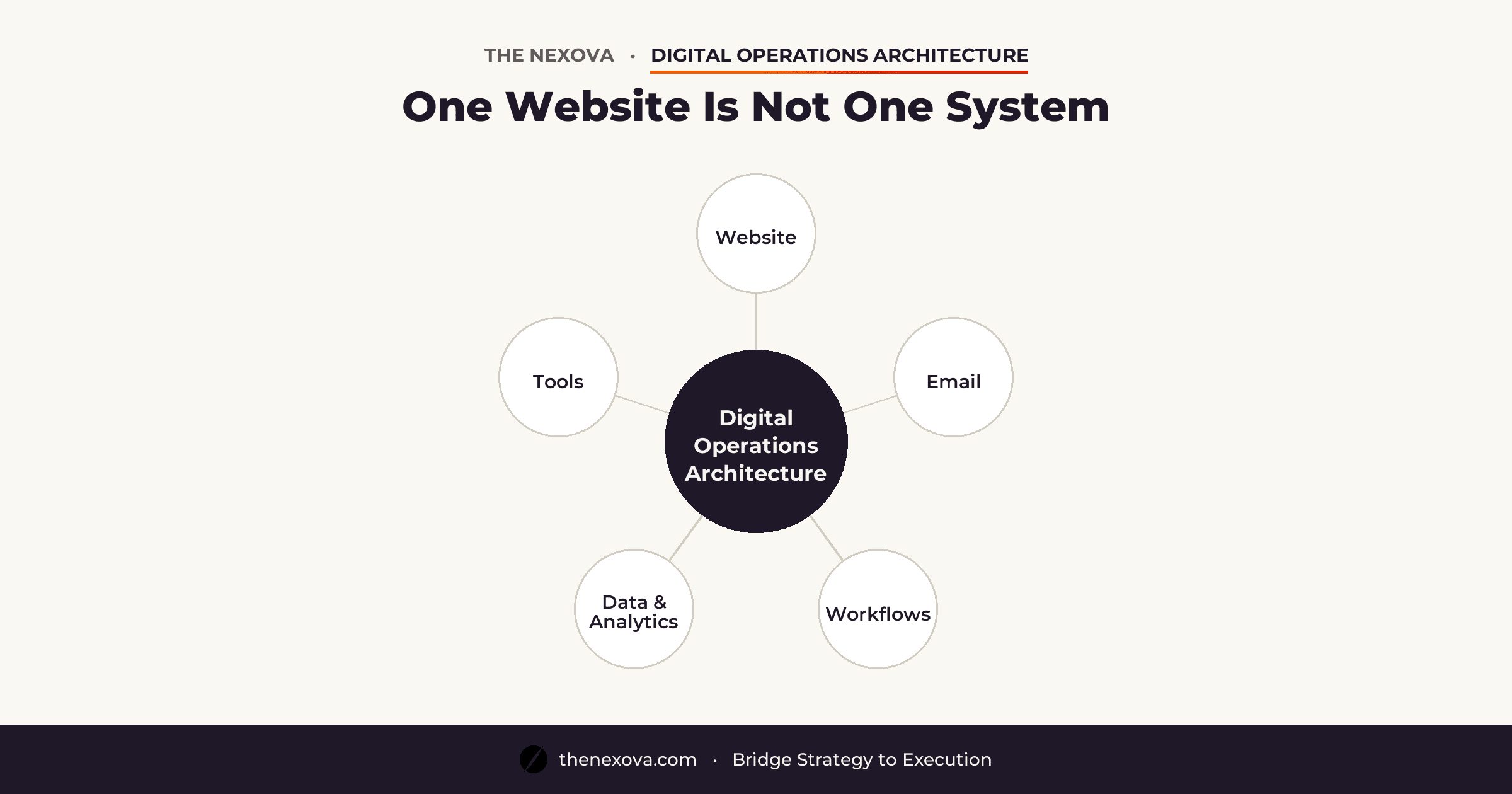
Digital Operations Architecture is the practice of designing a unified digital system where every component works together as one operational engine. Your website, email, workflows, data, and tools stop acting as separate projects and start acting as a single system, aligned with your business strategy from the start. Data then moves between them automatically, instead of living in someone's inbox.
Think of it this way:
| Web Development | Digital Operations Architecture |
|---|---|
| Starts with "What should the website look like?" | Starts with "What are your business goals?" |
| Deliverable: A website | Deliverable: A complete operational system |
| Success = website is live | Success = operations run on digital rails |
| Relationship ends at launch | Ongoing optimization and automation |
| Website as brochure | Website as operational tool (lead capture, data, booking) |
| Email is separate | Email integrated with CRM and workflows |
| No internal automation | Automated internal processes (approvals, reports, notifications) |
| Analytics = Google Analytics pageviews | Analytics = business KPIs on real-time dashboards |
What Does Digital Operations Architecture Include?
In practice, Digital Operations Architecture covers six components. Each one can technically exist on its own, but the value comes from designing them together, from day one, rather than patching them into each other later.
1. Digital Brand Presence
Domain, DNS, SSL, and a website designed as an operational tool, not just a brochure. Instead of sitting idle after launch, your website captures leads, collects data, enables bookings, and drives measurable business outcomes.
2. Business Communications
Professional email domain with automated responders, templates, and integration with your CRM. When a lead emails you, the system logs it automatically, assigns it, and triggers a follow-up workflow. Nobody has to notice the message and remember to act on it.
3. Operational Workflows
This is where Digital Operations Architecture earns its name: automated internal processes such as order processing, client onboarding, approval chains, report generation, notification systems. Using tools like N8N and Make, we design workflows around the steps a person currently repeats by hand. How much that removes depends entirely on the process, and the honest answer before measuring yours is that we do not know. McKinsey Global Institute estimates that roughly 30% of the activities in 60% of occupations could already be automated with current technology (McKinsey Global Institute). Most businesses, though, simply haven't mapped which of their own tasks qualify.
4. Data & Analytics Foundation
Real-time dashboards tracking the KPIs that matter to your business, not vanity metrics. Your CEO opens one dashboard and sees revenue, pipeline, operational efficiency, and team performance. Nobody has to pull numbers from five different tools before a Monday meeting.
5. Integrated Tool Ecosystem
CRM, accounting, HR, and communication tools connected into one unified system. Data flows automatically between systems. So nobody has to re-type a customer's details into a second tool, or promise to "update the spreadsheet later."
6. Security & Governance
Professional-grade backup, access control, and compliance measures round out the system. As a result, your digital operations stay protected, auditable, and scalable as headcount and transaction volume grow. They are no longer held together by shared passwords and personal email accounts.
Why This Matters More for Vietnamese SMEs
Vietnam has over 940,000 active businesses, and SMEs make up 98% of them (Vietnam News Agency). Most still run day-to-day operations on spreadsheets, Zalo messages, and manual handoffs between departments. That gap is exactly why the government's national digital transformation push treats SMEs as a priority, and it is also why so many SME websites go live and then quietly stop mattering: the site was never wired into how the business actually operates. It's why THE NEXOVA built its business-first approach to digital transformation around this specific pattern: diagnose the operational bottleneck first, then architect the system, rather than starting from a website template.
Who Needs This?
If your business currently:
- Runs on spreadsheets and manual processes
- Has a website that generates zero leads
- Uses 5+ disconnected tools with no integration
- Spends hours on repetitive tasks that could be automated
- Has no real-time visibility into business performance
Then you don't need "a better website." You need Digital Operations Architecture. This is, in fact, the same conclusion we reach with most SMEs during a business-first diagnosis: the bottleneck is rarely the website itself, and a redesign alone will not move any of the numbers above.
How THE NEXOVA Delivers This
Our approach follows the "Business First, Tech Second" methodology, delivered through three pillars: digital foundation, digital competence, and automation. It runs in four steps:
- Assess (free) - A 30-minute review of where your digital foundation actually stands
- Design - Blueprint of your unified digital system
- Execute - Implement everything in phased milestones with quick wins
- Measure - The same review again, so the difference shows in your own numbers, plus ongoing monitoring and new automations
Ready to architect your digital operations? Book a free 30-minute review and let's start with your business goals, not a website template.