

Vietnam's Digital Transformation Moment: And Why Most Companies Are Getting It Wrong
Digital transformation is the phrase on every boardroom agenda in Vietnam right now, and the numbers explain why. In 2025, the digital economy reached an estimated USD 72.1 billion, or 14.02% of GDP, up from 12.87% in 2021, according to a government press briefing reported by Vietnam News Agency. The government's target is 30% of GDP by 2030, so the digital economy still needs to roughly double its share of output in five years.
In this article
The pressure to digitalize is real. But so is the failure rate.
The Uncomfortable Truth About Digital Transformation
According to a landmark McKinsey study, fewer than 30% of digital transformations succeed, and only 16% achieve sustained, long-term improvement. BCG's research across 825 executives puts the baseline success rate at a similar 30%.
These are not outliers. Bain found that 88% of business transformations fail to achieve their original ambitions, despite significant investment and detailed planning (Bain & Company, 2024). So the question is not whether digital transformation is happening in Vietnam. It is. The real question is: why are so many companies spending so much and getting so little?
The Real Cause of Failure Is Not Technology
Most companies blame implementation: the software, the vendor, the timeline. But the data tells a different story. Because McKinsey's research found that 70% of transformation failures are caused by employee resistance and poor change management, not technology. Among companies that failed to engage their frontline teams, only 3% reported any success.
The pattern is consistent: businesses rush to buy tools before they understand the problem those tools are supposed to solve. As a result, the spending happens, but the operational change never does.
- Companies lacking strategic alignment between tech investments and business strategy erode 9% of market value on average (Deloitte, 2023).
- McKinsey estimates that roughly 30% of the activities in 60% of occupations could already be automated with today's technology (McKinsey Global Institute), yet most companies buy automation tools before mapping which of their own processes actually qualify.
Investing in a new website, a CRM, or an AI tool without a clear operational strategy is therefore not digital transformation. It's digital spending.
The Business-First Alternative
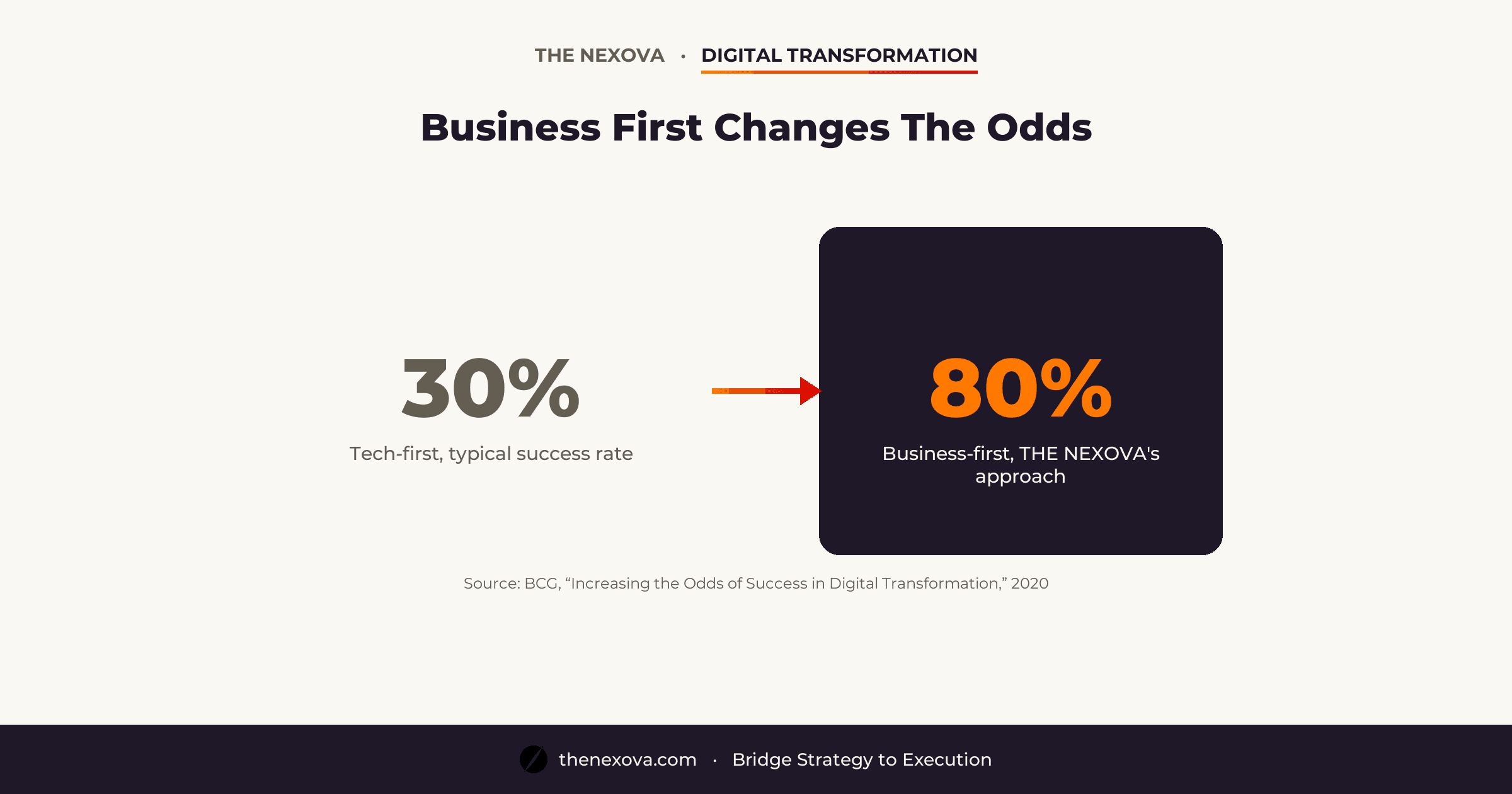
There is a better way, and the numbers back it up. Deloitte's 2023 analysis of 4,651 companies found that organizations with strong alignment between technology investment and business strategy achieved 2x higher valuations than their peers. Meanwhile, BCG found that companies applying a business-led approach flipped their odds of success from 30% to 80%.
The difference is not budget. It is not technology sophistication either. It's sequencing: understand the business problem first, then select the tool.
What This Looks Like in Practice
A business-first approach starts with three questions before any technology decision is made:
- What is the actual bottleneck? Not what looks inefficient, but what is measurably costing you money, time, or customers.
- What outcome defines success? Not "we adopted AI," but "we reduced order processing time by X%" or "we cut manual reconciliation hours by Y."
- Do our people and processes support this change? Technology can automate a broken process, but it cannot fix one.
Those three questions are the whole diagnostic, and they are deliberately boring. They come from operating inside companies that run at national scale, where the cost of buying the tool first is paid over the following two years. It is the same diagnose-first order behind our three pillars: measure, then build, then automate.
THE NEXOVA's Business-First Methodology
At THE NEXOVA, "Business First, Tech Second" is not a tagline. It's how every engagement starts. We do not begin with a technology recommendation. Instead, we begin with a diagnosis.
Our three pillars:
- Digital Foundation: The base a business needs to operate seriously from day one. One concrete deliverable here is Digital Operations Architecture: a unified digital infrastructure that connects your domain, communication, analytics, and workflows into one coherent system, not a website, but an operating system for your business.
- Digital Competence: Measuring where the organisation and its people actually stand, then closing the gap with role-based training rather than another tool.
- Automation & AI: Repetitive work that runs itself, with AI only where a model genuinely adds something, built on actual business requirements rather than trend-driven tooling.
Vietnam's SME Opportunity: The Window to Get It Right
Vietnam has over 940,000 active businesses, with SMEs making up 98% of all enterprises and contributing 40-45% of GDP (Vietnam News Agency). Because of this weight, the government's SME Digital Transformation Plan 2026-2030 (Decision No. 433/QD-TTg) targets support for at least 500,000 SMEs, with 300,000 expected to adopt advanced digital technologies by 2030.
The opportunity is significant. However, so is the risk of repeating the global pattern: investing in technology without the strategy to make it work.
SMEs that move now with a clear, business-led approach will build a durable operational advantage. Those that chase tools without strategy, instead, will spend the next three years unwinding bad implementations.
Where to Start
Digital transformation does not require a large budget or a complete overhaul. It requires clarity on where you are, where you need to be, and what the highest-leverage change looks like.
That's what our free 30-minute review is designed to answer: a focused conversation to diagnose your current operational state and identify where technology can deliver measurable impact.
Book a free 30-minute review and let's start with the business problem, not the technology solution.